
Printable Poker Cards
Need a deck for game night, a classroom maths activity or a custom party favour? This generator draws a full deck of playing cards — every pip laid out in the traditional pattern — at real poker or bridge size. Choose two- or four-colour suits, add your own card back, and print nine cards per sheet with cut marks. Card stock and a paper trimmer do the rest.
- Free to use
- No sign-up
- Runs in your browser
Printable card deck generator
Print at 100% (“Actual size”). Nine cards fit on each Letter or A4 page.
Card Game Printables
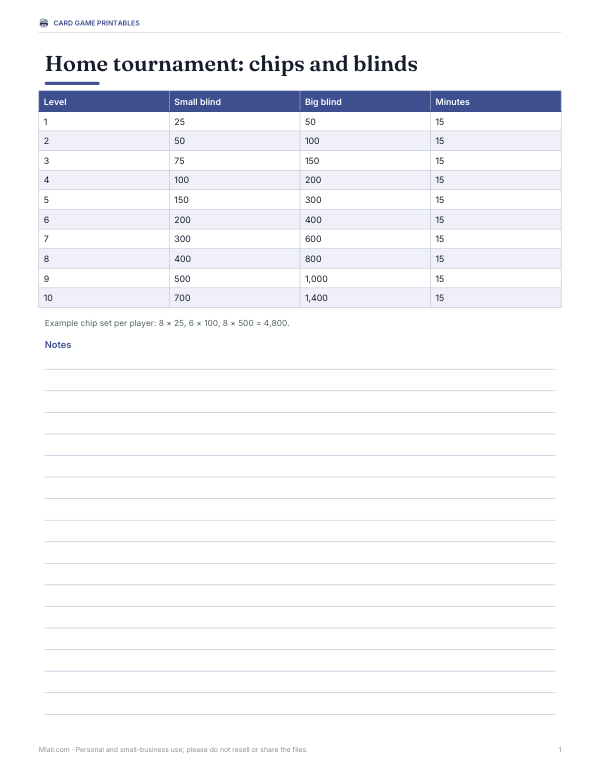
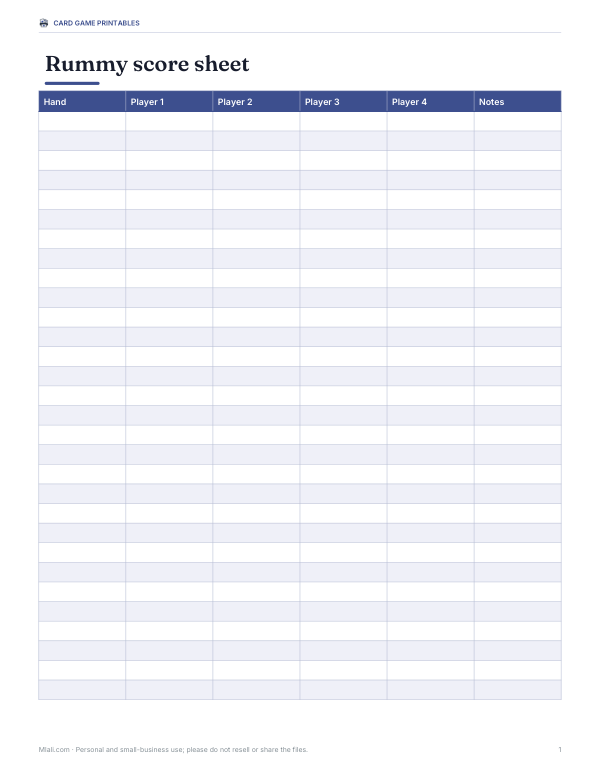
Printable poker hand ranking chart, chip values and tournament blinds sheet, score sheets for rummy, hearts, spades and cribbage, and a card game night planner.
- Hand rankings (PDF/XLSX)
- Chips & blinds (PDF/XLSX)
- Rummy scores (PDF/DOCX/XLSX)
- Hearts & spades (PDF/DOCX/XLSX)
- Game night planner (PDF/DOCX)
Formats: PDF, XLSX, DOCX. Instant download after payment (link valid 72 hours, up to 5 downloads). AI-assisted: the templates were drafted with AI help and reviewed and laid out before publishing.
$3.00 USD, one-time 5 files · about $0.60 each
- Instant download
- 7-day refund
- Secure checkout by Stripe
7-day money-back guarantee. Full refund within 7 days of purchase, even after you download.
Free sample: Chip Values and Blinds (PDF, 61 KB)
Full refund within 7 days — see the refund policy and license.
Free printables
Single sheets you can print right now, no sign-up. The full pack adds every sheet in one download plus the editable files.
 Printable Hearts and Spades Score Sheet
 Printable Card Game Night Planner
What you get
- All 52 cards — ace to king in spades, hearts, diamonds and clubs — plus two optional jokers.
- Corner indices at top left and bottom right, so cards read the right way up in a fanned hand.
- Number cards with pips in the traditional arrangement, so you can count the suit symbols.
- Simple, bold court cards (J, Q, K) that are easy to read.
- A custom back in your colour with your own text, printed separately.
Poker size or bridge size?
| Size | Dimensions | Notes |
|---|---|---|
| Poker | 2.5 × 3.5 in (63.5 × 88.9 mm) | The most common size; used in casinos and for most games |
| Bridge | 2.25 × 3.5 in (57.2 × 88.9 mm) | Narrower, easier to hold many cards — popular for bridge and rummy |
| Nine per page | 3 × 3 grid | Fits Letter and A4 with small margins |
How to print and cut your cards
- Load heavy card stock — around 80–110 lb cover (about 215–300 gsm) feels closest to real cards.
- Print the fronts at 100% scale (turn off “fit to page”).
- For double-sided cards, print the backs on the other side, flipping on the correct edge; test with plain paper first.
- Cut along the dashed cut marks with a paper trimmer or a craft knife and ruler.
- Round the corners with a corner punch if you have one — it stops them catching.
- For durability, slide each card into a clear card sleeve.
Why four-colour decks?
In a four-colour deck each suit has its own colour — usually black spades, red hearts, blue diamonds and green clubs. It makes hearts and diamonds (and spades and clubs) instantly distinguishable at a glance, which is why many online poker rooms offer it. It also helps younger players and anyone who finds red and black suits hard to tell apart in dim light.
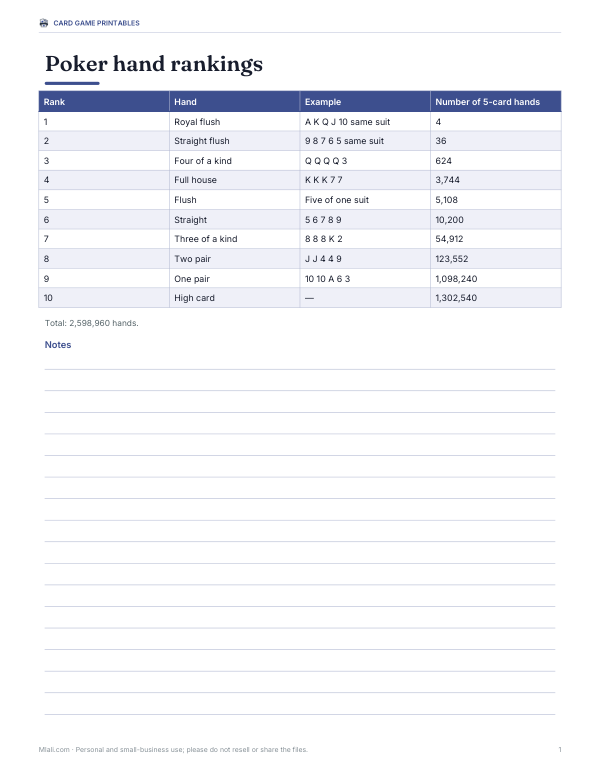
Poker hand rankings
| Rank | Hand | Example |
|---|---|---|
| 1 | Royal flush | A K Q J 10 of one suit |
| 2 | Straight flush | 9 8 7 6 5 of one suit |
| 3 | Four of a kind | Q Q Q Q 3 |
| 4 | Full house | K K K 7 7 |
| 5 | Flush | Any five of one suit |
| 6 | Straight | 5 6 7 8 9 of mixed suits |
| 7 | Three of a kind | 8 8 8 K 2 |
| 8 | Two pair | J J 4 4 9 |
| 9 | One pair | 10 10 A 6 3 |
| 10 | High card | None of the above |
In a standard 52-card deck there are 2,598,960 possible five-card hands; only 4 of them are royal flushes.
Card anatomy
| Part | What it is |
|---|---|
| Index | The rank and suit in the corners, readable when cards are fanned |
| Pips | The suit symbols in the middle of number cards, arranged so you can count them |
| Court cards | Jack, queen and king — traditionally with portraits; here shown as large letters |
| Back | The identical design on every card that keeps cards hidden |
| Jokers | Extra cards used as wild cards in some games |
Printing double-sided without misalignment
Most home printers shift the paper slightly between the first and second side, so backs can end up a millimetre or two off. The back design here has a wide border and a centred panel, which hides small shifts. Print a test sheet on plain paper, hold it up to a light to check the alignment, and adjust your printer’s “flip on long edge” or “short edge” setting before using card stock. If alignment is still off, print fronts and backs separately and glue them together with a glue stick before cutting.
Uses for a printable deck
- Replace a lost or damaged card in an existing deck (match the size).
- Maths lessons: probability, counting and number bonds.
- Party favours or wedding table games with a custom back.
- Prototype your own card game before ordering printed cards.
- Large-pip cards for players who find small print hard to read.
Worked example: paper needed
A full deck with two jokers is 54 cards. At nine per sheet that is six sheets for the fronts (54 ÷ 9 = 6) and six more for the backs if you print them separately — twelve sheets of card stock, or six if you print double-sided.
Card game printables pack
The optional pack includes a poker hand ranking chart, a poker chip value and tournament blinds sheet, score sheets for rummy, hearts, spades and cribbage, and a card game night planner. The deck generator above is free to use.
AI-assisted content
This page was drafted with AI assistance and reviewed before publishing. The card designs are original and simple; they are not copies of any commercial deck.
Frequently asked questions
What size are poker cards?
2.5 × 3.5 inches (63.5 × 88.9 mm).
How many cards fit on a page?
Nine, in a 3 × 3 grid on Letter or A4.
What paper should I print playing cards on?
Heavy card stock, about 80–110 lb cover (215–300 gsm).
What is a four-colour deck?
A deck where each suit has its own colour so suits are easy to tell apart.
How many cards are in a deck?
52, plus two jokers in many decks.
What beats a full house?
Four of a kind, a straight flush and a royal flush.
Can I print just one replacement card?
Yes — print the fronts page that contains it and cut out the card you need.